🗒️ The Tao Strikes Back
Management & investing psychology coming full circle, and hitting close to home.


Welcome to the fourth 🗒️ Builder Brief, where I share the notes behind The Builders — the half-formed ideas and mental models shaping the book in real time. These short reflections explore the areas where theory meets the messy reality of building — and how trial, error, and curiosity have forged the philosophy along the way.
Simple to a Fault?
“Knowing others is intelligence; knowing yourself is true wisdom.” —Tao Te Ching Chapter 33
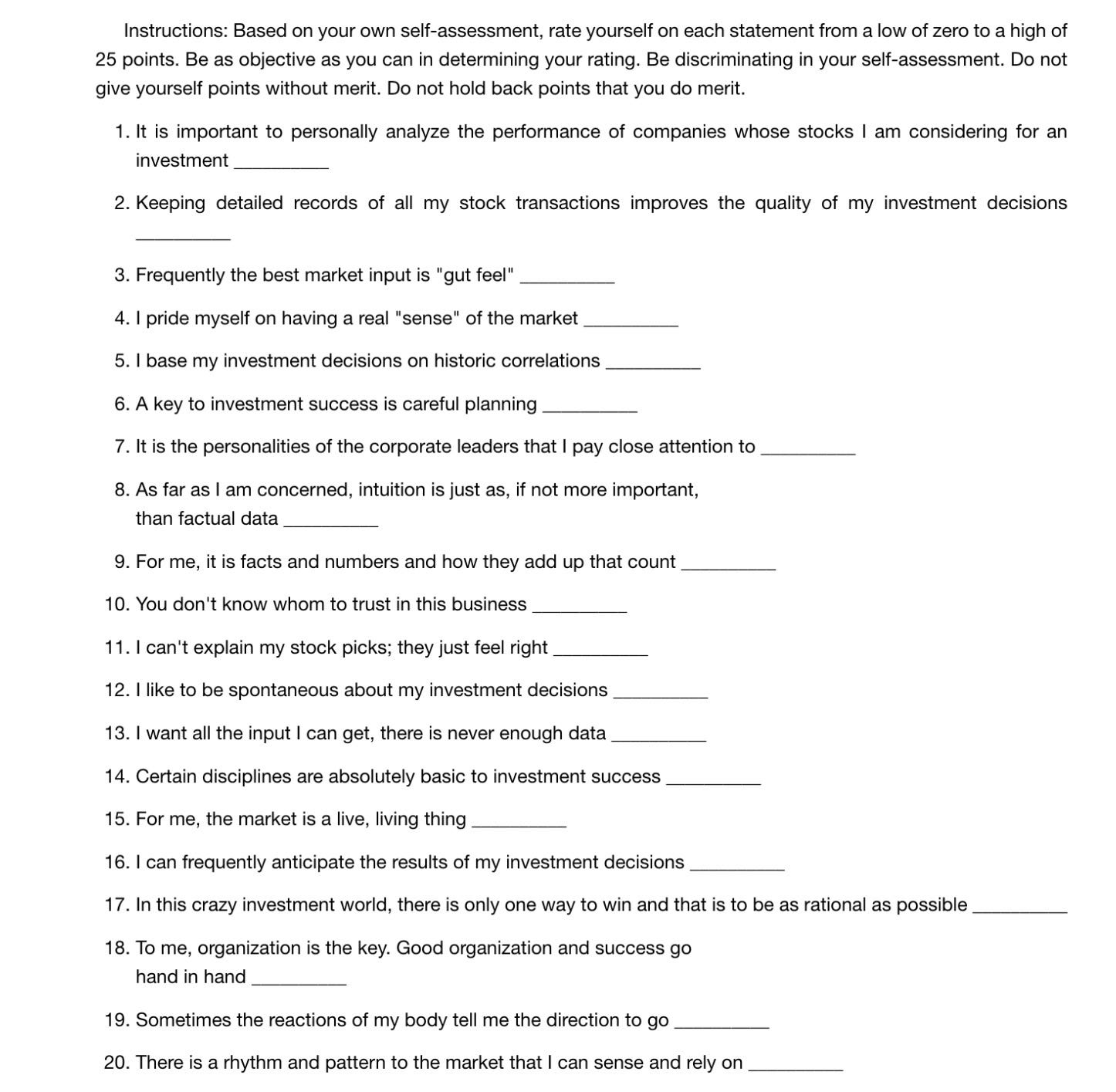
A few years ago, I read The Tao Jones Averages, which sought to apply the popular (particularly in the 1970s) brain hemisphere dominance tests to the investing realm. Its simple 20-question test has proved to be far more accurate than I would have guessed when I and my team took it. We have recently confirmed hemisphere dominance in each team member this past month, by taking the Herrmann Brain Dominance tests.
While I think most of my team was rightly skeptical of simplifying a brain’s 100-500 trillion neuronal connections into a simple classification system — the feedback from our test results and team session has been surprisingly positive. Even more surprising, is that our results largely matched the same experiment we did years ago with the simple 20-question test. That questionnaire is here, for anyone curious:
The big caveat, is that one of our younger team members that we collaborate with came out very differently in both tests. And I think the major reason is that “right brain,” intuitive and holistic views of the investment world are shunned, and so without longer experience, the most consensus-appropriate views are inherently left-oriented.
Daniel Kahneman is the psychologist that has influenced Wall Street the most, and his more right-brain-oriented counterpart Gary Klein has been relegated to the quaint sections of the book store. Kahneman conclusively would warn us all to not trust intuition, and instead rely on linear logic. But he also wasn’t against nonlinear abstraction. His caution on emotional impulses over-powered his messaging on the power of “System 2.”
Classifying him as left-brain psychologist is not giving him enough credit, and is an over-simplification — just like the HBDI tests.
But as I wrote in a prior post, having a simple framework is more useful than having no framework. Furthermore, analyzing extreme opposites is often helpful for understand the grey areas in between the black and white. There are far more dualities in the brain than right, left, top, bottom.
This doesn’t just show up in different functions or regions, but also competing chemicals and systems. Whether its dopamine vs. serotonin, GABA vs. glutamate, or the sympathetic system as opposed to the parasympathetic, each factor introduces more complexity and duality into the understanding of human behavior and psychology.
By studying the opposites, I find it’s easier to understand how to balance these dualities as opposed to being over-ruled by one extreme or the other.
Balance is the key to building.
Surfing, Not Stillness
“The highest good is like water. Water benefits all things and does not compete.” —Tao Te Ching, Chapter 8
One of my favorite pioneers of balanced brain management has been Pixar’s Ed Catmull, whom I’ve referenced many times in these posts. Ed had a great way of elaborating on the concept of balance in his book Creativity Inc:
“While the idea of balance always sounds good, it doesn’t capture the dynamic nature of what it means to actually achieve balance. Our mental image of balance is somewhat distorted because we tend to equate it with stillness—the calm repose of a yogi balancing on one leg, a state without apparent motion. To my mind, the more accurate examples of balance come from sports, such as when a basketball player spins around a defender, a running back bursts through the line of scrimmage, or a surfer catches a wave. All of these are extremely dynamic responses to rapidly changing environments.”

I love these analogies, because when we think about a balanced mind, we do tend to associate it with a Buddhist monk sitting by a lotus-flowered pond. We don’t tend to think about Hollywood studio heads sitting next to computer animators sitting next to directors, all trying to come up with the most emotionally-gut-wrenching stories that they can get away with a G-rating. It’s a tricky mission. But not one of withdrawal or stillness. Quite the opposite.
Furthermore, I only realized as I have been writing the final chapter in the book, some of the most magnificent achievements in our modern day economy have been achieved by teams of very extreme brains, occupying the most turbo examples of a “bottom right,” or “top left,” brain. Yet in every single scenario, these extremists were balanced by trusted co-founders, co-executives or even family members.
Trust and a shared mission are key, as these competing extreme dualities often mean that the Builders are speaking in totally separate languages. Points of view as simplistically different as “I think,” vs. “I feel,” can often explode into doubt, disrespect or even denial.
So trust and a shared mission are key — as (hopefully) nearly all marital partners have well understood. When speaking different languages, sharing different points of view may bring about clashes and hurt egos, so this trust between team members is absolutely critical. It’s also important to trust ourselves. Catmull goes on:
“The mechanisms that keep us safe from unknown threats have been hardwired into us since before our ancestors were fighting off saber-toothed tigers with sticks. But when it comes to creativity, the unknown is not our enemy. If we make room for it instead of shunning it, the unknown can bring inspiration and originality.”
That part of ourselves that will achieve the most incredible things will need a safe environment to express itself. But that initial expression is often not market-ready. But it is a crucial part of the creation process. As Catmull points out, in the beginning, most of Pixar’s scripts totally “suck.” A culture of candor must be rooted in respect, which inherently means we must see counterpoints as interesting information, counter-thesis data, and market feedback.
Finding Another Way, or Tao
“There is another way of looking at the world.” — A Course in Miracles, Lesson 33
And that’s what I find so elegant about the Herrmann brain dominance test.
Saying there are no “correct” answers is not about everyone getting blue ribbons. It’s about understanding there are different skillsets and different points of view for very different layers of the value creation process.
We can’t all be a Picasso, just as much as we can’t all be a Henry Ford in an organization. And that’s why >95% of Fortune 100 companies still utilize the Herrmann Brain Dominance Instrument. Is it the killer app?
No.
There’s far more to the psychology of value creation than simply finding balance, particularly in the basic hemispheres.
However, in the most toxic organizations, the cultures are cut-throat, and the employees are all competing against each other to climb a hierarchical ladder that leads to misery. There is no sharing of views, no candid feedback.
That cut-throat competitive culture is what Satya Nadella found when he came into Microsoft, as he vividly and candidly explained in his wonderful memoir Hitting Refresh. Larry Culp undoubtedly found the same culture when he entered GE, as decades of Jack-Welch MBA indoctrination had driven a “whatever it takes,” culture that rewarded hitting quarterly numbers over any economic substance.
So how perfect is it, that just like Pixar’s Ed Catmull, both executives turned to eastern philosophy to inspire a different way. Nadella would attempt to “rediscover the soul,” of his company by revamping Microsoft’s cut-throat and performance-driven culture to one that broke the monopoly, collaborated with competing technologies, and urged passion and purpose for everyone.
“And so what is soul in this context of a company? I don’t mean soul in a religious sense. It is the thing that comes most naturally. It is the inner voice. It’s what motivates and provides inner direction to apply your capability. What is the unique sensibility that we as a company have? For Microsoft that soul is about empowering people, and not just individuals, but also the institutions they build.”
And please note, there is nothing fluffy or light about Nadella.
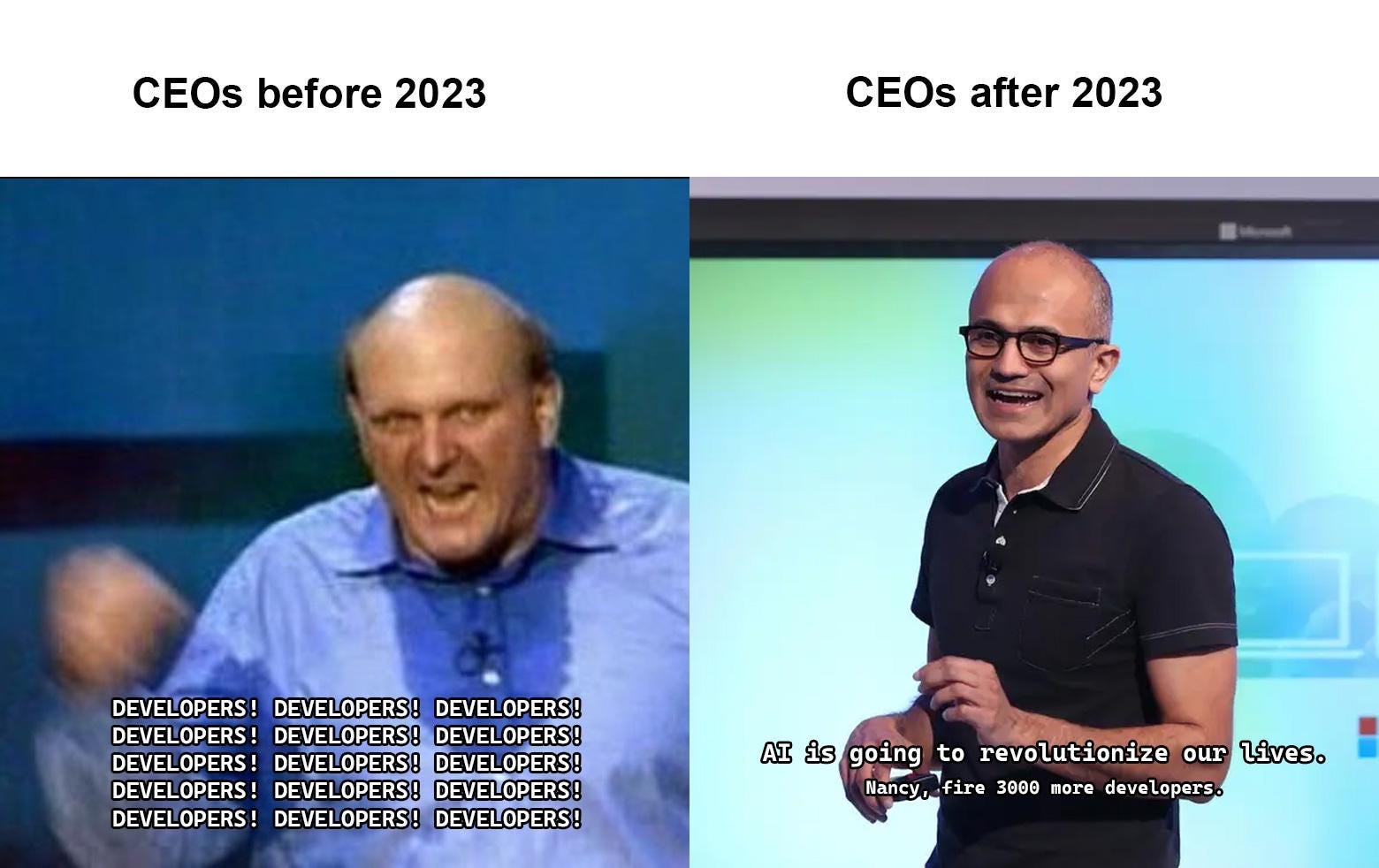
He’s intense. He wants to win. He’s not off meditating by a pond. He’s not Buddhist. But despite memes making fun of his embrace of AI, he has embraced empathy, emotions, creativity and balance in the way a surfer finds the sweet spot on the board, and rides the wave.
Few executives have been able to ride the most important waves of the last decade better than Nadella has.
Also interesting is that while Catmull, Nadella and Culp drew cornerstones of their management philosophy from eastern culture, they didn’t throw out the western playbook of linear thinking, organizational structures and performance-backed by accounting. They would incorporate both perspectives into their management style, and inadvertently bring the same balance that I’ve been advocating for in all these posts.
Had that happened in the 70’s, I don’t think certain sects of psychology would have rejected the brain dominance theory quite so suddenly. Unfortunately, the whole-brain movement got wrapped up in the post war protests and flower power cultural under-currents.
Right brain creativity was rather simplistically correlated to Taoism and eastern thought. The command & control, hierarchical political history of the war-focused administrations were correlated to the left brain, and the over-simplification of both the theory and the science took over popular culture.
Revisionist History
“Yield and overcome. Bend and be straight.” -Tao Te Ching, Chapter 22
What I find most interesting, if not tragic, is that this counter culture movement ended up turning not just the academic world against the brain dominance theories, but also the economic world.
Ned Herrmann, who popularized the brain dominance tests, was actually the head of GE’s executive management training program. His task in the 70’s was to find a way to bring the organization back to being more innovative, creative, and forward-thinking. Around the same time, neuroscientists were making tremendous inroads on learning the differences between the various parts of our brain.
He would famously change the way that not only GE would work, but NASA, and many other key innovators. But Ned Herrmann left GE in 1981—the exact same year Jack Welch took the helm.
Welch would rip out the HBDI from the training academy, and would see it as “soft.” Instead, he would enforce an accounting-oriented MBA program on his management recruits. The miracle of two decades of consecutive earnings “beats and raises,” would enamor the entire corporate world, and GE’s training academy would become even more worshipped — far more than under Ned Herrmann.
High profile, and very wonderful managers would then go onto most businesses to run much of the Fortune 100. But some of these would also go onto Boeing, 3M, Chrysler, and Home Depot — resulting in spectacular near-death experiences.

Curiously, all of these companies had unique founder-oriented and innovative cultures prior to the GE playbook coming in. Every time, these cultures were subverted to becoming earnings machines. They all nearly collapsed, around the same time that GE itself ended up on the brink of bankruptcy.
That is, until the Tao struck back.
Today, the GE accounting-focused culture is a high profile embarrassment for all management training programs. Now the HBDI is back, and nearly all Fortune 100 companies are utilizing it.
It’s a welcome development. But I think today we also risk the same mistake as Welch in the 80’s, if we completely throw out his playbook and ignore quarterly results.
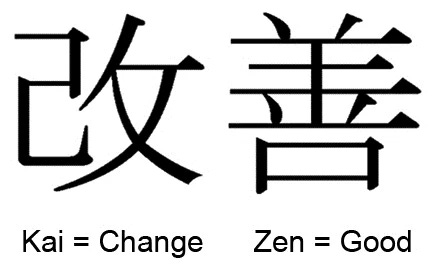
GE has embraced a culture of “all feedback matters,” and the entire organization is part of resuscitating industrial giant. They have collectively added back nearly half a trillion in market capitalization through an Eastern-oriented Kaizen culture, but they also produce results. It’s not a softer company — it’s more inclusive. But it’s still in turbo mode. It’s just that the “Tao,” has struck back.
The Tao Strikes Back
"The rigid and hard will be broken. The soft and yielding will overcome." -Tao Te Ching, Chapter 76
Herrmann’s test is back.
Much like the Tao Te Ching reads a bit like the wisdom of Yoda, we routinely overlook the wisdom of the master, and instead focus on the fight between the two sides.

But if I’ve discovered anything after trying what feels like all the management systems, is that it’s not about one way or another — as the Tao Te Ching would advise. Despite the fact that “Tao” stands for “the way,” in reading its text, it is very open to many perspectives, many ways. In fact, the eastern blend of more right-brain oriented Tao with left-brain oriented Confucianism ideas would balance a symbiosis that created the world’s first and most advanced mega economy.
It wasn’t one or the other, but both.
We have to have both sides to the GE story. We have to find balance. This is not a match between good and evil, right and wrong, accounting vs. culture — or rather, left vs. right. It’s about creating durable growth, innovation, and movements that last.
The only way that has ever happened is by enabling a highly diverse team that can go not just win in the world, but build it anew — each member honoring their own skill-set.
Or as the Tao te Ching advises: “The sage has no fixed mind; he takes as his own the mind of the people.”
The best builders have no fixed mind, or fixed view; they make room for other minds, other tools and other views. That is how they find the Tao.
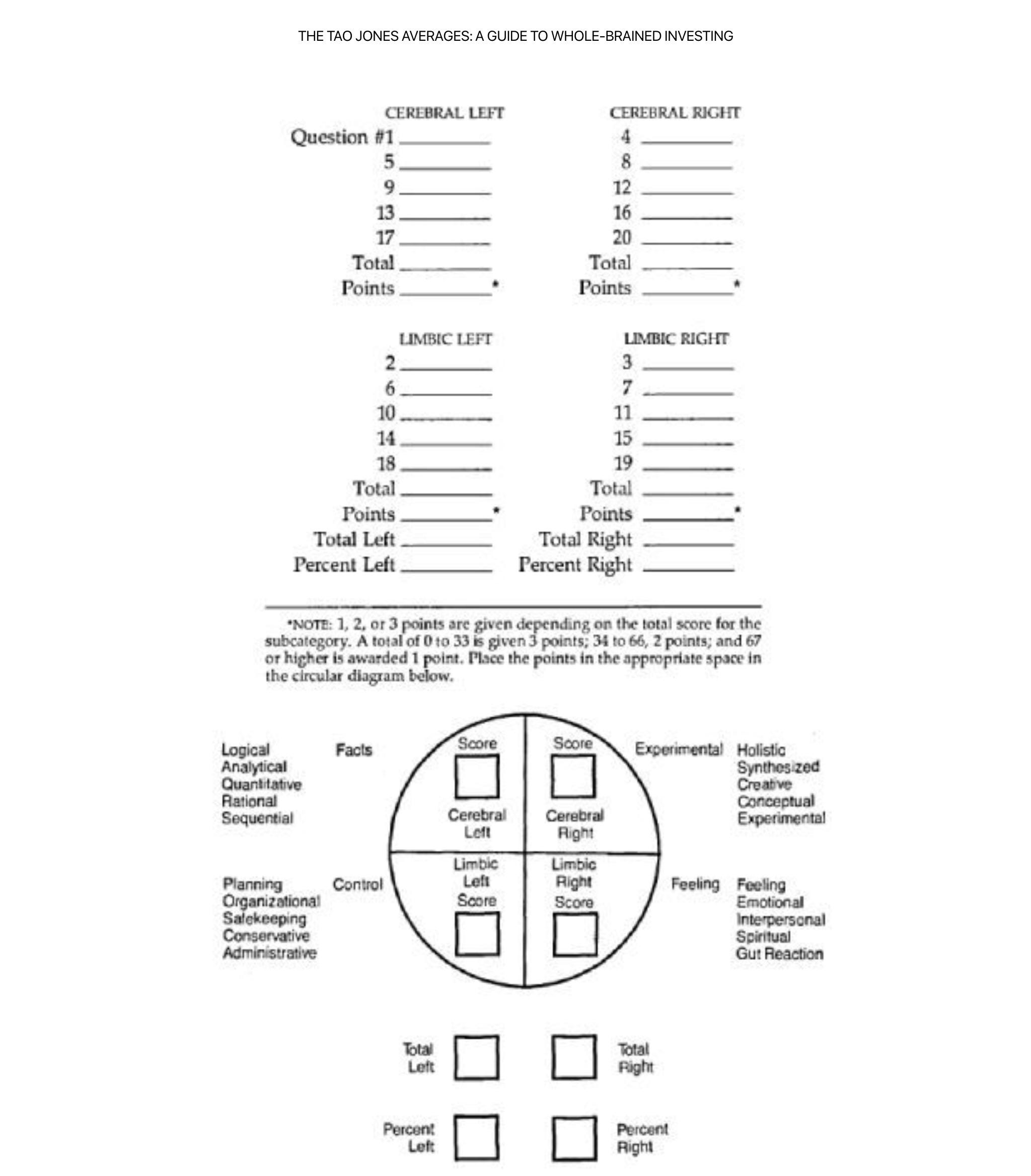
Answer key from test in beginning:
 | A guest post by
|
 | A guest post by
|